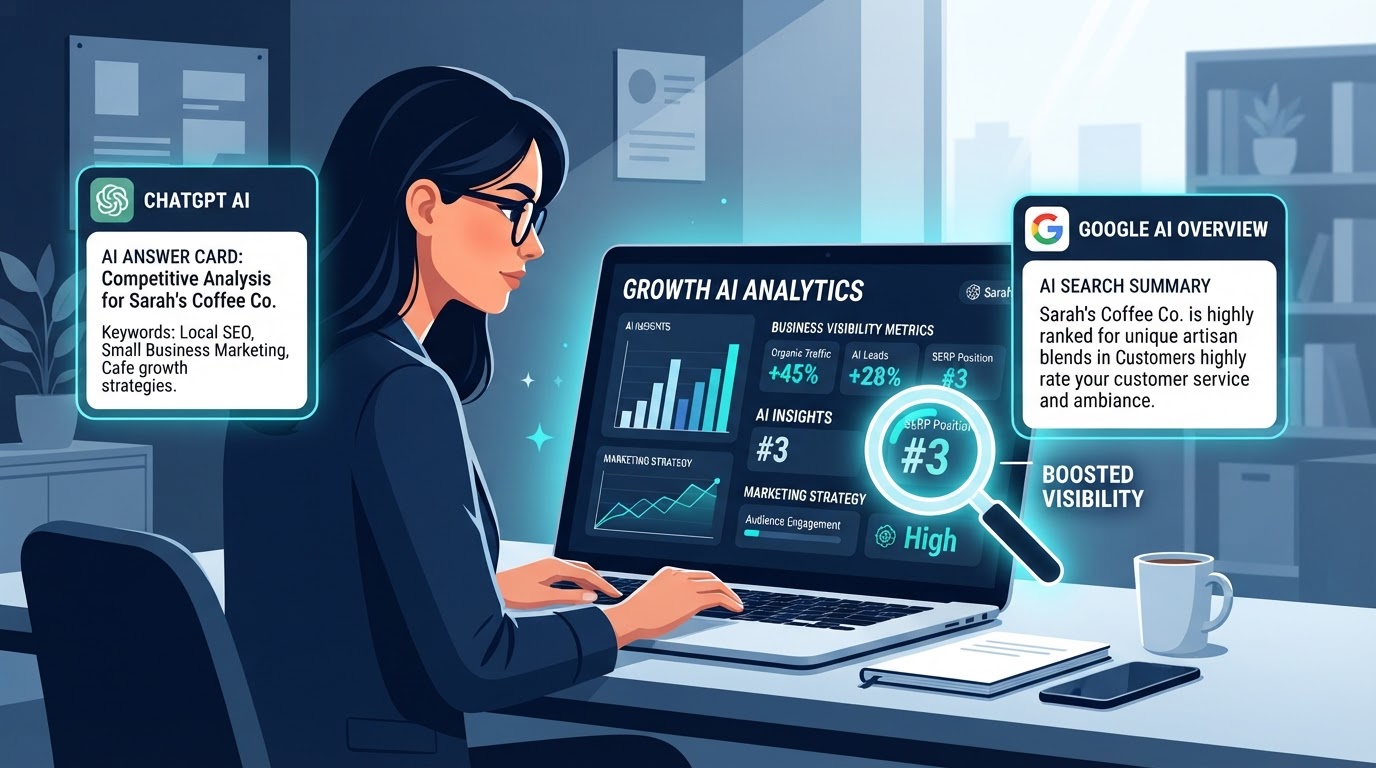
Here's a question most small business owners haven't asked yet: when someone asks ChatGPT to recommend a business like yours, does your company appear? Think about that for a moment. A potential customer could be asking who's a good electrician near them, whether you can recommend an orthodontist for their teenager, which printing companies specialize in product packaging, or what's a good marketing company for a small business. What happens when an AI assistant answers? Does it mention your company? Does it recommend your competitors? Does it even know your business exists? There's a way to start finding out, and you don't need to be a computer expert to do it.
What Is AI Search Visibility?
AI search visibility refers to how often and how accurately your business appears in AI-powered search experiences such as ChatGPT, Google's AI features, and other AI search tools. In traditional SEO, businesses often track where their websites rank for certain Google searches. AI search works differently. Instead of showing only a list of websites, an AI tool may generate an answer that summarizes information from multiple sources. That answer might mention your business, cite your website, or recommend a competitor. AI visibility is about understanding whether your business is being included in these kinds of answers. If you're new to the subject, start with our guide on what AEO is — a simple guide for small business owners.
Why Should Small Businesses Check Their AI Visibility?
Imagine you own a plumbing company in Austin, Texas. You search Google for 'plumber Austin' and see your website on the first page. Great! Now you open ChatGPT and ask, 'Which plumbing companies in Austin specialize in tankless water heater installation?' Your business isn't mentioned. Instead, you see three competitors. That doesn't mean your website has a technical problem or that those competitors always appear ahead of you. But it does raise a useful question. Does your website clearly explain that you install tankless water heaters? Maybe your homepage only says 'Residential Plumbing Services.' If so, improving your service descriptions might help customers and search tools better understand what your company offers.
Step 1: Write Down the Questions Customers Might Ask AI
Start with ten questions that a potential customer might ask when looking for your products or services. Don't simply use your business name. Think about how people search when they don't already know who to hire. For a landscaping company, those questions might include: who installs sprinkler systems near me, what's a reliable landscaping company in my city, which local companies design backyard patios, who can repair a broken irrigation system, what landscapers offer free estimates, who installs retaining walls near me, can you recommend a lawn maintenance company, which landscaping companies have good customer reviews, who designs low-water landscapes, and which companies provide commercial landscaping services.
These are examples. Your actual questions should reflect what your customers need. Be careful with questions that include claims like 'best,' 'cheapest,' or 'highest-rated.' AI answers may not have enough reliable information to support those comparisons.
Step 2: Ask ChatGPT the Questions
Open ChatGPT and use its web search capability when available. Ask one of your questions, including the city or service area. For example, 'Can you recommend companies that install residential sprinkler systems in Austin, Texas?' Read the answer carefully. Look for whether your company appears, which other businesses are mentioned, whether the answer contains website links or citations, whether the information is accurate, and whether your services are described correctly. Write down what you find, then repeat the process with your other questions.
Remember that ChatGPT may respond differently to the same question at another time, in another conversation, or for a different user. Your results are observations, not permanent rankings.
Step 3: Check Google AI Search
Google also offers AI-powered search experiences, including AI Overviews and AI Mode. Try the same questions on Google. Some searches may produce AI-generated answers while others may display traditional results. When AI answers are available, check whether your business appears or whether your website is cited. Don't assume that appearing in traditional Google results means you'll automatically appear in an AI-generated answer. The two experiences can present different sources and businesses.
Step 4: Try Other AI Search Tools
You can also test relevant questions in tools such as Perplexity and other AI assistants that support web search. Different platforms may return different answers. One might mention your business while another doesn't. That's normal. AI tools don't all use the same search systems or sources. For a small business, it's usually better to begin with a few important platforms rather than trying to monitor everything at once.
Step 5: Compare Your Business With Competitors
Now look at the businesses that appear in answers where yours doesn't. Visit their websites. Ask yourself: do they have more detailed service pages, do they explain exactly which cities they serve, do they answer questions your website doesn't, are their business details easier to find, do they show real projects, experience, or customer reviews, and are they mentioned on relevant industry websites? You might discover that your competitors provide better information about a particular service. That's something you can improve.
However, don't assume every competitor mention is caused by a specific website feature. AI search systems are complicated, and the exact reasons for individual recommendations aren't always visible.
Step 6: Review Your Website
Here's a simple self-check. Can someone quickly find the answers to these questions on your website: what does your business do, what are your main services, who do you help, where do you operate, how can someone contact you, what makes your business different, what questions do customers commonly ask, can visitors find examples of your work, is your business information accurate, and does the website work well on mobile phones? If you can't find the answers easily, your customers may have trouble too. Improving these areas helps both traditional search and AI-powered discovery. Our article on AEO vs. SEO explains why these improvements work together.
Step 7: Track Your Results Over Time
One test isn't enough to understand your entire AI search presence. Save the questions you tested and check them again periodically. For example, you could review the same ten questions once a month. Keep track of whether your business appears, which competitors are mentioned, and whether the answers describe your business accurately. A simple tracking sheet might list each customer question alongside whether your business was mentioned in ChatGPT and in Google AI. You can also record whether an AI answer links to your website. Keeping the questions consistent makes it easier to compare what you observe over time. For more useful comparisons, record the date, location, platform, and exact wording of each question.
Can Google Analytics Show Visitors From ChatGPT?
Sometimes, yes. When visitors click links from ChatGPT or other AI platforms, Google Analytics may identify them through referral information or tracking parameters. You can look for traffic associated with sources such as chatgpt.com. Keep in mind that not all visits from AI tools will be identifiable. Someone may discover your company in an AI answer and later visit your website directly or search for your company by name. That makes it difficult to measure the full influence of AI search.
Can Google Search Console Track AI Search?
Google Search Console can help website owners understand their search visibility. Google introduced reporting for generative AI search performance in 2026. Where available, this gives website owners another way to examine impressions and clicks associated with AI-powered search experiences. The exact information available depends on Google's reporting features and your website's data. Search Console won't tell you every time every AI assistant recommends your business, but it's useful alongside your website analytics and direct AI search testing.
What Is an AI Visibility Report?
An AI Visibility Report is an assessment of how your business appears across selected AI-powered search experiences. A useful report might include questions customers are likely to ask, whether your business appears in selected AI answers, which competitors are mentioned, whether AI descriptions of your business are accurate, whether your website is linked or cited, important website and business information issues, and suggested improvements. The best reports don't just give you a complicated score. They help you understand what you can actually do next. For example, a report might identify that your website doesn't have a dedicated page for your most popular service. That's something you can fix.
Can an AI Visibility Checker Guarantee Accurate Results?
No tool can perfectly measure every recommendation across every AI platform. AI-generated answers can change based on the question, timing, location, available sources, and other factors. Some tools run repeated searches and record how often businesses appear. That's useful for understanding patterns. But you should be skeptical of a report that claims your business has one exact, universal AI ranking. There isn't one permanent leaderboard of every business inside ChatGPT.
What Should You Do If Your Business Doesn't Appear?
Don't panic, and don't immediately pay for an expensive service. Start with the basics. First, make sure your website is accessible to search engines and relevant AI search crawlers. Next, check whether your service descriptions are clear. Then review your business listings and the questions your website answers. If your company offers specialized services, explain them in detail. And if you have real examples of work, publish them. For more practical advice, see our guide on how to get your business recommended by ChatGPT. No improvement guarantees a recommendation, but these steps make your website more useful and discoverable.
The Bottom Line
AI-powered search is becoming another way customers discover businesses. You don't need to understand every technical detail to get started. Ask the questions your customers are asking. See whether your business appears. Check the information for accuracy. Compare the available sources. Then improve the parts of your online presence that need attention. The goal isn't to chase a perfect AI ranking. It's to make your business easier to discover and easier to choose.
Find Out How Your Business Appears in AI Search
At Ollerton Marketing, we help small businesses understand their online visibility and identify practical improvements. If you're curious whether ChatGPT and other AI tools are mentioning your company, an AI visibility assessment can be a useful starting point. Interested in a Free AI Visibility Report? Visit OllertonMarketing.com to learn more and contact us about your business.
Frequently Asked Questions
Can I check my AI search visibility for free?
Yes. You can manually ask relevant questions in AI search tools and record the answers. Some paid tools offer additional monitoring and reporting.
Can ChatGPT tell me how my business ranks?
ChatGPT can sometimes find and summarize information about your business, but it can't provide a single permanent ranking across all AI search experiences.
How often should I check my AI visibility?
For many small businesses, reviewing a consistent set of important questions monthly is a reasonable starting point.
Why does ChatGPT recommend competitors instead of my business?
There can be many reasons, including available sources, the wording of the question, location, and the information AI tools can find. One answer doesn't establish the cause.
Can AI search bring customers to my website?
Yes. Some AI-powered search experiences include links that people can click to learn more about businesses.
How do I improve inaccurate AI information about my business?
Start by correcting your official website and important business listings. Clear, consistent information gives search tools better sources to work with, although corrections may not appear immediately.
Do I need an AI visibility report?
Not necessarily. You can perform a basic check yourself. A report becomes more useful when you want to compare many questions, competitors, or platforms.
Want this working for your business?
Ollerton Marketing builds smart websites, AI chat, automations, and media buying for local businesses — plans start at $97/month.